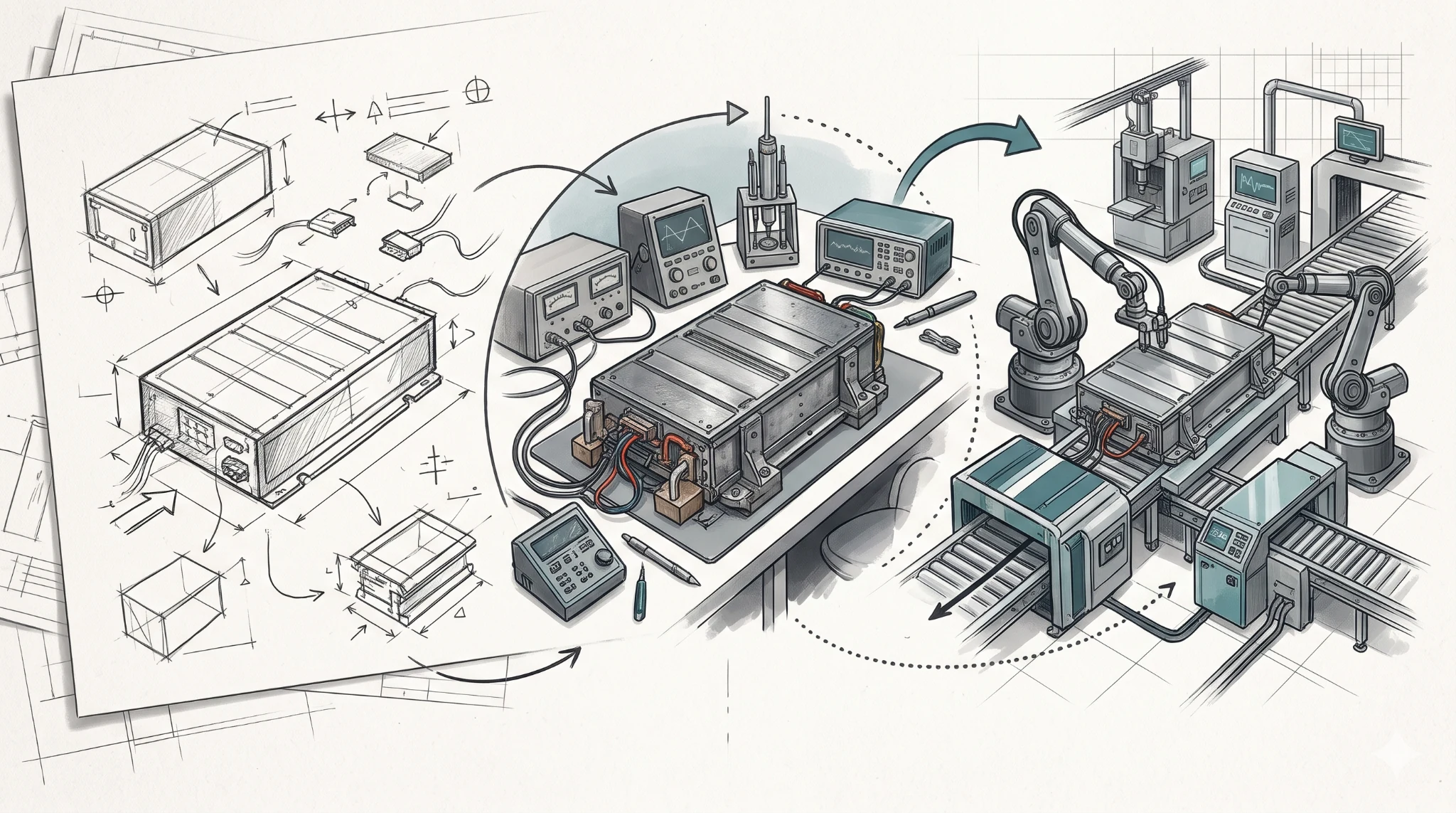
A prototype works. The team knows how to assemble it, correct its issues and demonstrate its performance. The first customer is interested. It is tempting to conclude that the hard part is over and that the next task is to increase production.
But a prototype and a scalable product answer different questions.
A prototype shows that a solution can work. A product must work repeatedly, for more than one customer, under defined conditions, with quality and service that the business can sustain economically.
The prototype carries invisible support
Early prototypes often depend on the knowledge and attention of the people who built them. Engineers know which component needs adjustment. A specialist can diagnose an unusual response. A developer can intervene manually. A founder may personally manage the installation and customer expectations.
This is acceptable during learning. It becomes a problem when the business assumes the same arrangement can support a larger customer base.
The knowledge that makes the prototype work must be converted into designs, procedures, tolerances, test methods, documentation, training and support arrangements. Otherwise, repeatability depends on individual memory and exceptional effort.
Productisation changes the problem
A scalable product requires attention to several connected dimensions:
Reliability: Does it perform consistently over time, across expected operating conditions and with defined failure behaviour?
Manufacturability: Can it be produced repeatedly with controlled variation, available materials, capable suppliers and acceptable lead times?
Quality assurance: Can the business inspect, test, document and trace the product in a consistent way?
Serviceability: Can customers install, operate, maintain and repair it with a support model the supplier can deliver?
Integration: Can the product work within customer environments without excessive one-off engineering?
Economics: Do production cost, warranty exposure, support effort and working-capital needs allow the business to earn an acceptable return?
These are not administrative additions after engineering. They influence product architecture and should be considered while the design can still change.
Design for the conditions of repeatability
Suppose a specialised instrument produces excellent results in a laboratory demonstration. Scaling may require component sourcing plans, calibration procedures, environmental tolerances, operator training, service coverage and documented quality controls. If those requirements are discovered only after early sales, the product may need expensive redesign.
The same pattern appears in industrial automation, advanced materials, software-enabled equipment and other deep-tech offerings. The prototype proves a technical concept; commercial scale demands a complete delivery system.
A useful approach is to create explicit productisation gates. At each gate, ask what has been demonstrated, what remains dependent on expert intervention, what must be standardised and what evidence is needed before the next level of customer exposure.
Do not confuse volume with scale
Producing more units is not necessarily scaling. If every additional unit requires disproportionate engineering support, custom integration or rework, volume can increase workload without producing a repeatable business.
Scale should be measured through the ability to deliver the intended customer outcome consistently as volume and customer variation increase. That includes the economics of supporting the product after sale.
The strategic implication
The transition from prototype to product is a change in the unit of analysis. The question moves from “Can our team make this work?” to “Can our organisation deliver this outcome repeatedly, reliably and profitably?”
A business that plans for productisation early can use technical learning to shape a more scalable design. A business that delays the question may find that its most successful prototype has become an expensive operating model.
Related reading
Continue exploring this collection: Execution — Sustaining the Advantage
Browse all articles · Ideas & Insights
Interested in the decisions behind technology-led growth? Explore Work With Me →
Continue reading in this collection

Build an Operating Rhythm That Converts Strategy into Results
A strategic operating rhythm connects milestones, evidence, accountability and resource decisions so leaders can adapt execution as conditions change.
Read article →
The Execution Gap Usually Begins with a Missing Decision
When priorities, ownership or authority remain unresolved, more activity cannot compensate for the decisions the organisation has not made.
Read article →
From 30 Ideas to 3–5 High-Value Growth Opportunities
Narrowing a broad idea set requires a common evaluation logic that tests customer value, strategic fit, capability, economics and evidence.
Read article →