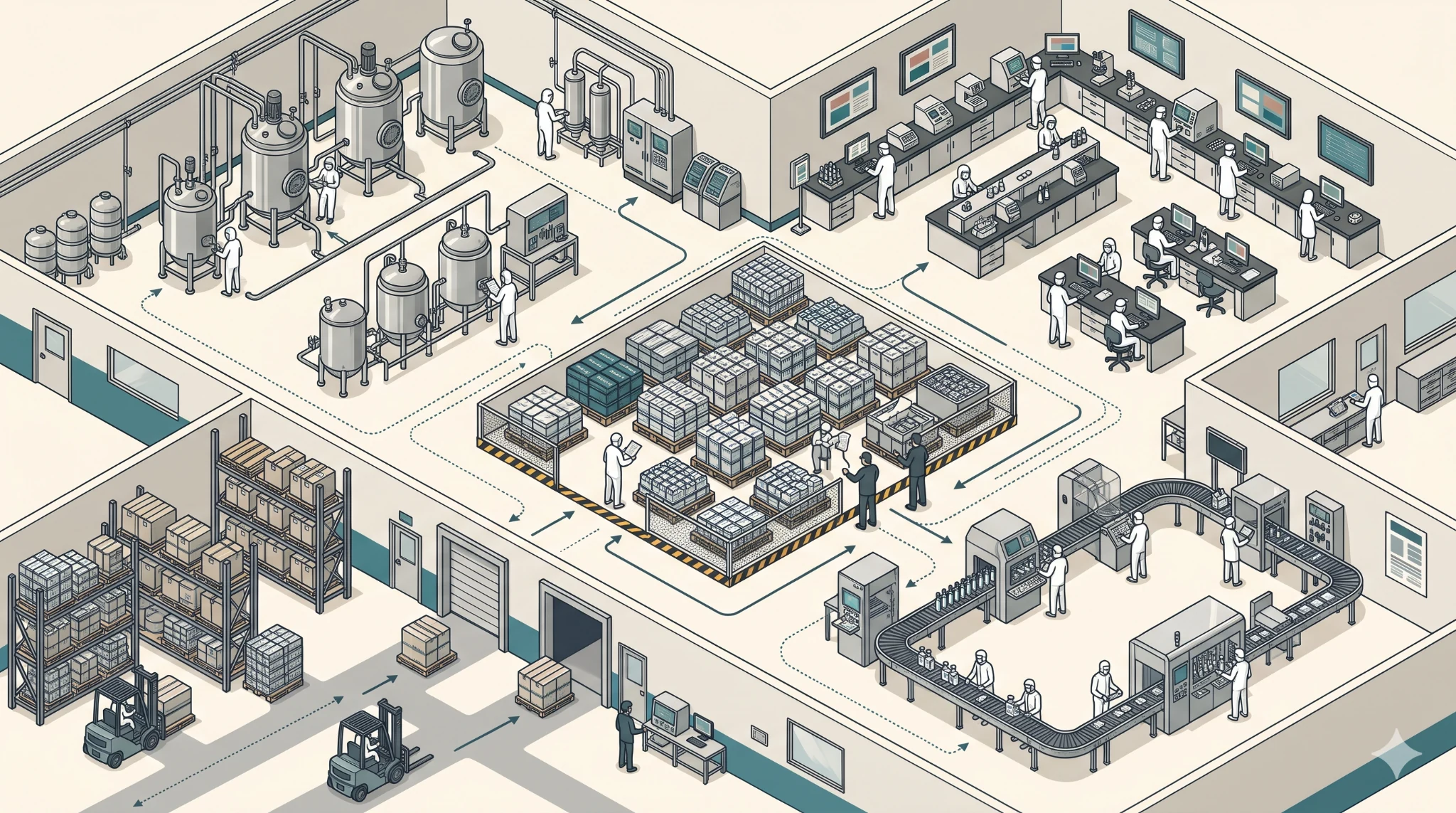
A manufacturing business can have a capable sales team, experienced engineers, efficient production operations and a disciplined finance function—and still disappoint customers and underperform economically.
Sales wins work that engineering has not fully scoped. Engineering designs solutions that operations cannot produce consistently. Operations protects utilisation by prioritising stable runs, while customer commitments require flexibility. Finance controls cost but lacks visibility into the operational consequences of delayed investment.
Each department may be performing reasonably well against its own measures. The enterprise is not.
This is the difference between functional strength and enterprise capability.
The outcome is produced between departments
Customers do not experience a company as a set of departments. They experience a promise, a product, a delivery, an installation, a service response and the consequences of using what the company supplied.
Those outcomes depend on multiple functions working together. The value of sales depends partly on engineering's ability to define a deliverable offer. Engineering's work depends partly on the quality of customer information. Production performance depends on planning, procurement, quality and maintenance. Cash conversion depends on commercial terms, operational execution and billing discipline.
The interfaces are part of the operating system.
Local optimisation can create enterprise loss
A department's target may be sensible in isolation but harmful in combination. Sales may be rewarded for order intake without regard to delivery complexity. Production may be measured on utilisation without accounting for the cost of late changes. Procurement may optimise purchase price while increasing lead-time risk. Finance may delay a capability investment because its value appears in another function's results.
These are not simply communication problems. They are incentive and decision-design problems. Each actor responds to the signals and constraints it sees. If the enterprise needs coordinated behaviour, it must make the shared outcome visible and align the rules that shape decisions.
Map the critical dependencies
Leaders should identify a small number of outcomes that matter most—such as on-time delivery, first-pass quality, profitable order fulfilment or successful customer adoption—and trace the functions that influence them.
For each dependency, ask:
- What information must move from one function to another?
- Who owns the decision at the boundary?
- Which local metric could encourage a conflicting action?
- What must be escalated, and how quickly?
- How will the enterprise measure the combined outcome?
This reveals where the system needs shared definitions, clearer authority, better information or redesigned incentives.
Build capability around the enterprise result
A business does not need every function to agree on every detail. It needs coordination where decisions are interdependent and appropriate autonomy where they are not.
For example, a standard product line may benefit from clear production rules and limited variation, while a new application may require closer engineering-commercial collaboration. The operating model should reflect the actual dependencies instead of imposing the same process everywhere.
The strongest capability combinations become difficult to copy because they involve routines, information, experience and coordination across the organisation—not one isolated department.
The strategic implication
When performance is disappointing, leaders often ask which department needs to improve. That is sometimes the right question. But when the problem repeatedly appears at the boundaries, the better question is whether the enterprise system enables functions to create value together.
A strong department is an asset. A strong enterprise is the result of making those assets reinforce one another.
Related reading
- The Handoffs That Determine Industrial Performance
- How Complementary Capabilities Create More Value Together
Continue exploring this collection: Resilience — Confluence of Capabilities
Browse all articles · Ideas & Insights
Interested in the decisions behind technology-led growth? Explore Work With Me →
Continue reading in this collection
Preserve Optionality: Stage Gates, Reversibility and Commitment
Staged investment and reversible decisions allow leaders to learn before making large commitments, while protecting the ability to change direction.
Read article →
Design Experiments to Kill Assumptions, Not Confirm Them
Design experiments to expose the assumptions that could invalidate an idea before committing more time, money and capacity.
Read article →
The Evidence Trap: Why More Data Does Not Always Reduce Uncertainty
More research can create the appearance of rigour without resolving the assumptions that matter. Good evidence is decision-relevant, not merely abundant.
Read article →