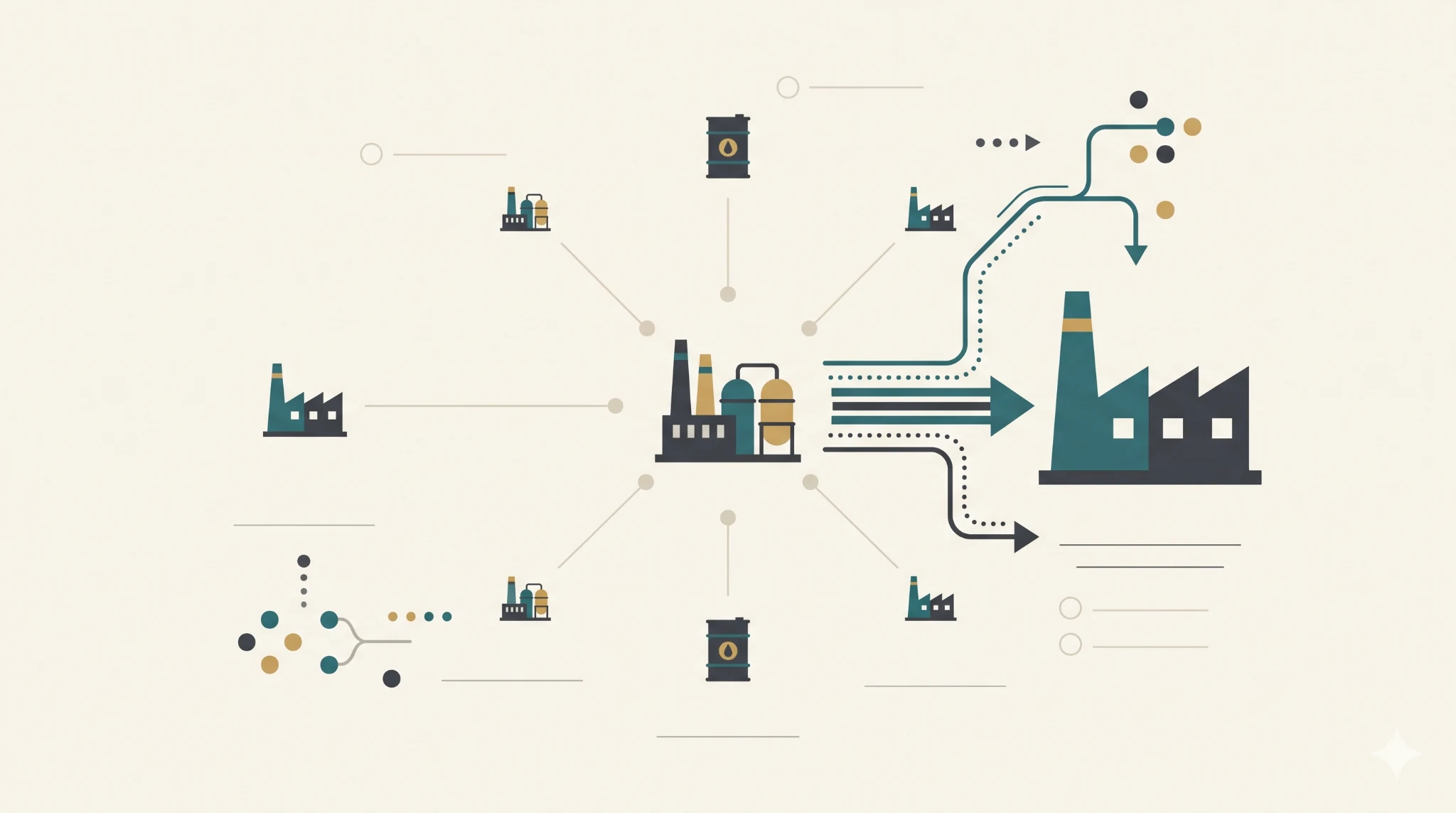
A supplier with a small number of large customers can look unusually strong. It may be deeply integrated into customer operations, involved in engineering decisions, qualified for critical applications and trusted to deliver consistently. Competitors may find it difficult to displace.
Yet the same supplier may be exposed to a small number of purchasing decisions. One customer can delay an order, renegotiate terms, shift production or change its sourcing strategy—and the supplier's business can feel the effect immediately.
Customer concentration can therefore create two opposing forces: embeddedness that protects the relationship and dependence that weakens the supplier's negotiating position.
The apparent contradiction
A concentrated supplier relationship can create a meaningful competitive advantage. The supplier may have accumulated technical knowledge, application experience and operational routines that make its contribution difficult to replace. The customer benefits from continuity and avoids the cost and risk of qualifying an alternative.
But concentration also means that a large share of the supplier's revenue may depend on a few buyers. The supplier may hesitate to challenge an unfavourable price, payment term or scope request because losing the account would create a significant financial shock.
The relationship can be operationally sticky while commercially unbalanced.
Measure two different kinds of power
Leaders should avoid treating customer retention as evidence of supplier power. A customer may stay because switching is expensive, while still exercising strong control over price, timing and commercial conditions.
Two questions help separate the dynamics:
- How difficult is it for the customer to replace the supplier? Examine qualification effort, integration, accumulated knowledge, continuity and the availability of credible alternatives.
- How difficult is it for the supplier to replace the customer? Examine revenue dependence, customer-specific assets, dedicated capacity, working-capital exposure and the time required to develop other accounts.
A healthy strategic position improves the first answer without making the second dangerously high.
The hidden cost of serving a dominant customer
Customer-specific work can make a supplier valuable, but it can also absorb engineering capacity, require dedicated inventory, create bespoke production processes or extend receivable cycles. If those investments cannot be reused elsewhere, the supplier may be building a customer asset more than an enterprise capability.
This is especially important when a supplier supports a customer's growth but does not participate proportionately in the economics of that growth. Volume may increase while margins, cash conversion or bargaining power deteriorate.
The issue is not that large customers are inherently undesirable. A large anchor customer can provide predictable demand, reference value and a platform for learning. The issue is whether the relationship produces capabilities and economics that strengthen the supplier beyond the account itself.
Build transferability into the relationship
A supplier can reduce fragility by converting customer-specific learning into reusable capabilities where confidentiality and contractual obligations permit. Application knowledge may inform a broader product architecture. Quality practices may improve delivery to several customers. Engineering tools may become standard methods. Service models may be adapted to adjacent applications.
This does not mean copying one customer's confidential requirements into another account. It means distinguishing proprietary customer information from general learning and capability that the supplier legitimately develops through experience.
The business should also set boundaries around dedicated investments, payment exposure, forecast commitments and change requests. Commercial terms should reflect the resources and risks required to support the relationship.
The strategic implication
Customer concentration is neither automatically a moat nor automatically a weakness. Its effect depends on the balance between customer switching costs and supplier dependence.
The leadership test is to ask whether deepening the relationship makes the supplier more valuable, more capable and more resilient—or simply more exposed to one buyer. A strong anchor relationship should become a platform for enterprise strength, not a single point of failure.
Related reading
Continue exploring this collection: Strategy — The Power of a Moat
Browse all articles · Ideas & Insights
Interested in the decisions behind technology-led growth? Explore Work With Me →
Continue reading in this collection

Why Focus Can Produce Disproportionate Returns
Focus can deepen knowledge and capability faster than spreading scarce resources across a much larger market.
Read article →
Find the Asymmetry Hidden in the Customer's Value Chain
A supplier can create disproportionate value by solving an overlooked problem at a critical point in the customer's wider value chain.
Read article →
Turn Constraints Into Strategic Design Choices
Constraints can shape a focused business model when leaders design around limited capital, capacity and market access.
Read article →