Market entry is often described as a launch. The business selects a geography or segment, prepares a product, appoints a distributor and announces its presence. The launch creates visible activity, but it does not prove that the company can win in the market.
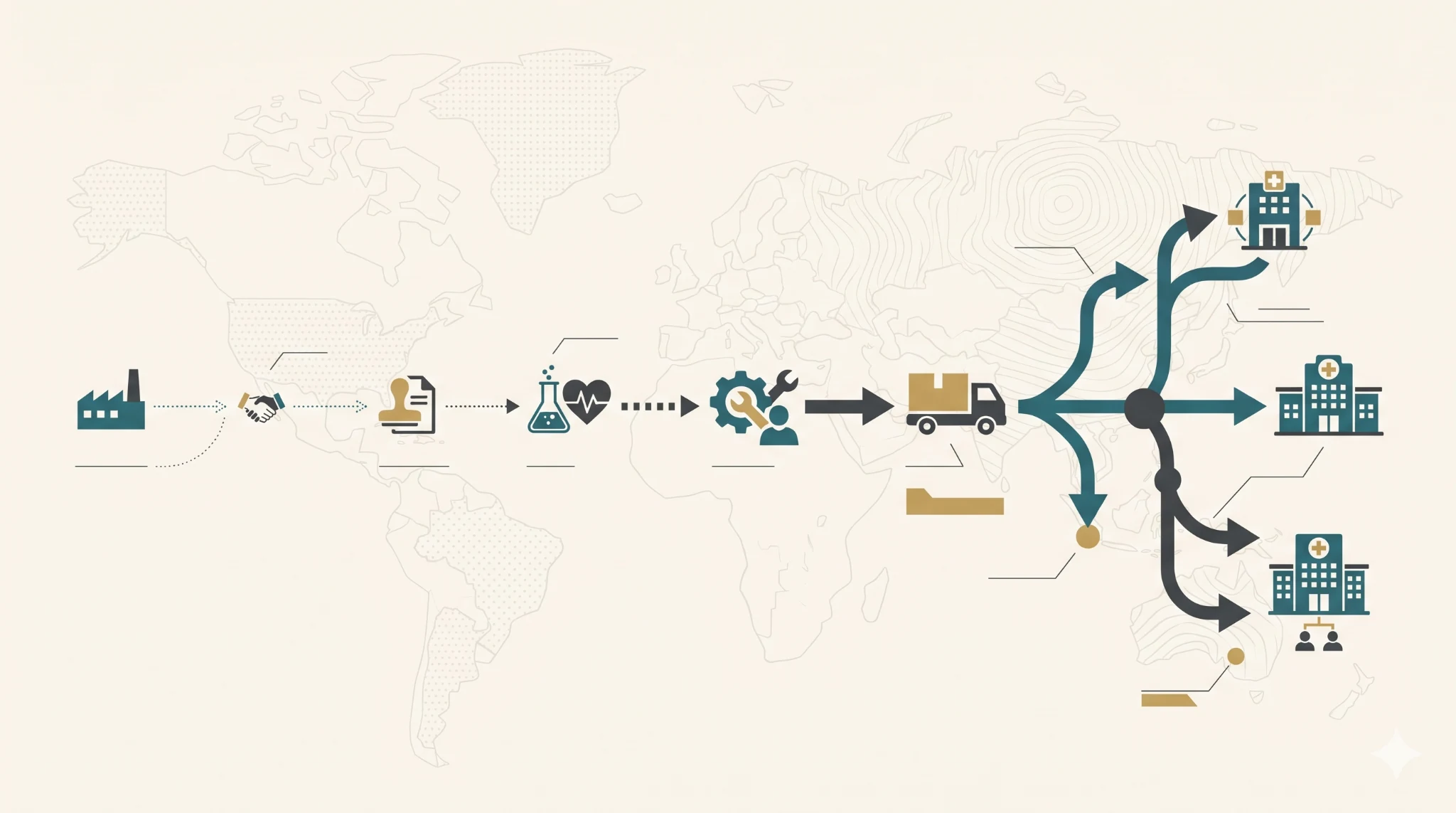
A market entry decision is better understood as a sequence of commitments. Each stage should resolve a different uncertainty and justify the next level of resource allocation.
A launch can hide several untested assumptions
A business entering a new market may assume that customers have the same problem, that its current product is suitable, that local channels can reach buyers, that pricing will transfer and that service requirements are manageable.
Some assumptions may be correct. Others may fail only after the company has incurred fixed costs, hired a team or committed inventory.
The purpose of staged entry is not to eliminate uncertainty before acting. It is to avoid making large, difficult-to-reverse commitments while critical assumptions remain untested.
Think in stages of evidence
Stage 1: Define the target and reason for entry. Identify the segment, customer problem, strategic fit and reason the business believes it can compete.
Stage 2: Establish access. Determine how the business will reach users, technical evaluators, budget owners and purchasing channels. Early conversations should test the buying process, not just interest.
Stage 3: Validate the value proposition. Test whether the customer recognises the problem, whether the proposed outcome matters and what alternatives are used today.
Stage 4: Prove adoption and delivery. Use a bounded pilot, qualification process, channel trial or initial deployment to understand integration, service, fulfilment and operating requirements.
Stage 5: Commit to scale. Increase investment when the evidence supports a repeatable proposition, credible economics and a feasible delivery model.
These stages are not a rigid formula. Some can overlap, and a regulated or capital-intensive market may require additional gates. Their purpose is to connect spending to learning.
Define what would change the decision
Each stage should have explicit decision criteria. What evidence would justify proceeding? What would require changing the segment or offer? What result would cause the business to stop?
Without these conditions, a pilot can become a permanent pilot, a distributor relationship can remain a symbolic market presence and a launch investment can continue simply because the organisation has already spent money.
The criteria should reflect the size and reversibility of the commitment. A small experiment can tolerate more uncertainty than a dedicated plant, acquisition or major capacity investment.
Preserve the ability to change course
Staged entry is valuable because it preserves options. The business can revise pricing, focus on a narrower application, use a partner instead of building its own channel or stop before committing additional capital.
This is not indecision. It is disciplined sequencing: make the next commitment when the evidence justifies it, not merely because the previous activity has created momentum.
The strategic implication
The question is not simply, “Are we entering this market?” It is, “What must we learn first, what commitment does that evidence justify and what must be true before we invest at the next level?”
That turns market entry from a one-time launch event into a managed process of discovery, validation and deliberate commitment.
Related reading
- What Must Be True Before You Commit Capital?
- Preserve Optionality: Stage Gates, Reversibility and Commitment
Continue exploring this collection: Strategy — The Power of a Moat
Browse all articles · Ideas & Insights
Interested in the decisions behind technology-led growth? Explore Work With Me →
Continue reading in this collection

Why Focus Can Produce Disproportionate Returns
Focus can deepen knowledge and capability faster than spreading scarce resources across a much larger market.
Read article →
Find the Asymmetry Hidden in the Customer's Value Chain
A supplier can create disproportionate value by solving an overlooked problem at a critical point in the customer's wider value chain.
Read article →
Turn Constraints Into Strategic Design Choices
Constraints can shape a focused business model when leaders design around limited capital, capacity and market access.
Read article →