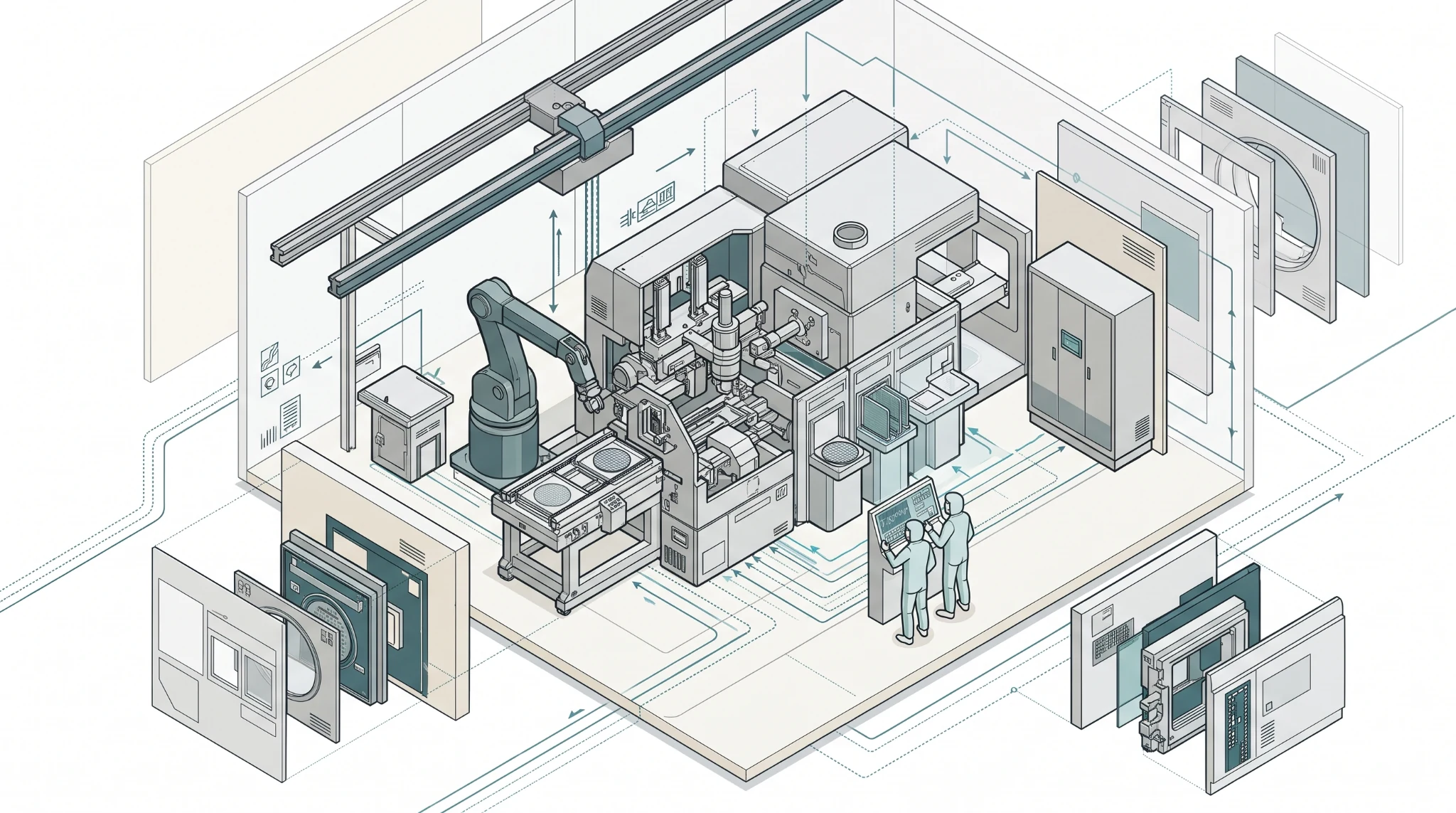
A supplier does not become strategically important simply because it has served a customer for a long time. Ten years of transactions may represent a durable relationship—or a contract that the customer would replace tomorrow if a better alternative appeared.
The difference lies in the consequences of replacement.
A business becomes difficult to replace when the customer's cost of changing is greater than the apparent benefit of switching. That cost is not limited to a cancellation fee. It can include qualification, process redesign, retraining, data migration, operational disruption, quality risk, service continuity and the loss of accumulated knowledge.
Understanding these consequences reveals the economics behind customer embeddedness.
Replacement is a decision with multiple costs
Customers rarely compare suppliers on price alone when the purchased product or service affects a critical operation. They also consider the cost and risk of moving from the current arrangement to another one.
For an industrial buyer, changing a component supplier may require engineering review, sample testing, process qualification, documentation updates, production trials and approval from several stakeholders. A lower quoted price may not compensate for the time, uncertainty and operational exposure involved.
The incumbent supplier may therefore have an advantage even when its product is not the cheapest. But that advantage is only as strong as the customer's actual replacement burden and confidence in the incumbent's continued performance.
Embeddedness is created through useful work
A supplier becomes embedded when its contribution is connected to the customer's operating system. It may understand application-specific failure patterns, participate in engineering changes, integrate with planning systems, maintain validated configurations or support a critical process.
These activities can reduce friction for the customer. They can also create accumulated knowledge that a replacement supplier would need time to rebuild.
The strongest form of embeddedness is not artificial dependency. It is a position in which the supplier consistently makes the customer's operation better, more predictable or less risky. The customer stays because the relationship creates value, and because replacing that value involves real transition work.
The same mechanism can become a liability
There is a strategic limit. A supplier can be deeply embedded in one customer and still be fragile as a business. If most revenue comes from a small number of buyers, the customers may possess substantial bargaining power. They may demand price reductions, extended payment terms, additional engineering support or capacity commitments.
The supplier may be difficult to replace in the short term while remaining highly dependent on the customer in the long term.
This is why customer embeddedness and supplier bargaining power should be analysed separately. One describes the customer's cost of leaving. The other describes the supplier's exposure to the customer. They can move in different directions.
Examine the economics on both sides
Leaders should map the replacement economics from the customer's perspective:
- What operational activity depends on the supplier?
- What must be retested, requalified or redesigned before a switch?
- What knowledge has accumulated through the relationship?
- What could go wrong during transition, and who carries that risk?
- How quickly could a credible alternative restore equivalent performance?
Then examine the supplier's own economics:
- How much revenue depends on this customer?
- Are margins improving as the relationship deepens, or is support becoming more expensive?
- Can the accumulated capability be transferred to other customers or applications?
- Does the customer recognise the value of the supplier's contribution in commercial terms?
The aim is to identify whether embeddedness creates mutual value or one-sided dependence.
Becoming difficult to replace should improve the customer's position
A durable supplier position is strongest when the customer's reasons to stay are positive: less downtime, reliable quality, faster engineering resolution, lower lifecycle cost or reduced execution risk. The supplier should be able to demonstrate these outcomes rather than rely on the inconvenience of switching.
The strategic question is not, “How do we lock customers in?” It is, “What valuable part of the customer's operation can we support so well that replacing us would require a meaningful rethink?”
That is the economics of becoming difficult to replace. It is built through relevance, accumulated contribution and demonstrated performance—not dependence engineered for its own sake.
Related reading
- Switching Costs Are Designed, Not Discovered
- When Customer Concentration Becomes a Hidden Moat—and a Risk
Continue exploring this collection: Strategy — The Power of a Moat
Browse all articles · Ideas & Insights
Interested in the decisions behind technology-led growth? Explore Work With Me →
Continue reading in this collection

Why Focus Can Produce Disproportionate Returns
Focus can deepen knowledge and capability faster than spreading scarce resources across a much larger market.
Read article →
Find the Asymmetry Hidden in the Customer's Value Chain
A supplier can create disproportionate value by solving an overlooked problem at a critical point in the customer's wider value chain.
Read article →
Turn Constraints Into Strategic Design Choices
Constraints can shape a focused business model when leaders design around limited capital, capacity and market access.
Read article →